



“Mistakes Were Made” is a monthly newsletter by Socratic CPG that dives deep into a case study related to the CPG industry. The newsletter is lengthy and intended to be read over the course of a month and saved for reference as needed by entrepreneurs and team leads. These thought-provoking case studies are not one-size-fits-all prescriptions. All case studies are based on real-world observations; however, I have taken the liberty to anonymize (to protect the innocent) and add a touch of drama (to engage the reader). I hope you find them thought-provoking and entertaining.
Executive Summary
Item changes are often necessary during an item's lifecycle and can result from customer feedback, regulatory concerns, or profit motives. Due to the complex nature of the CPG ecosystem, the success of an item change is not measured solely by whether the update was pushed to the shelf. Instead, success is determined by evaluating whether the process was smooth and whether the costs, both in terms of time and money, were appropriately forecasted. In short, the more seamless the change for the brand, its partners, distributors, retailers, and consumers, the more successful the change was.
Neville And His 2oz Catnip
Neville is the CEO of a shelf-stable cat food company selling D2C and B2B. Two years ago, Neville’s company introduced a line of catnip to their assortment, but the co-packer that had the capability to fill their specific jars and the capacity to take them on in the timeframe they needed was unable to completely fill the 2oz jar due to the straw-like consistency of the catnip. Neville’s company decided that expediency was critical and made the decision to under-fill the containers with approximately 1.9oz measure and labeled the jars accordingly. They determined it was better to slightly under-fill each jar and call it out on the label than to possibly overfill the jars, causing quality concerns with completely closing the lids. Reaching a full 2oz fill would be a project they would continue to tackle once the product was in the market.
After two years in the market, Neville has confirmed that the item has a strong market fit and has become a core part of their portfolio. During this time, his team has occasionally attempted to find a solution for a full 2oz fill. They have worked with their co-packer on a multi-year volume guarantee, contingent on the co-packer investing in upgrading the filling machine to prevent overflowing and ensure proper lid sealing. Neville directs his team to commit to the co-packer's terms and begin the process of changing the item.
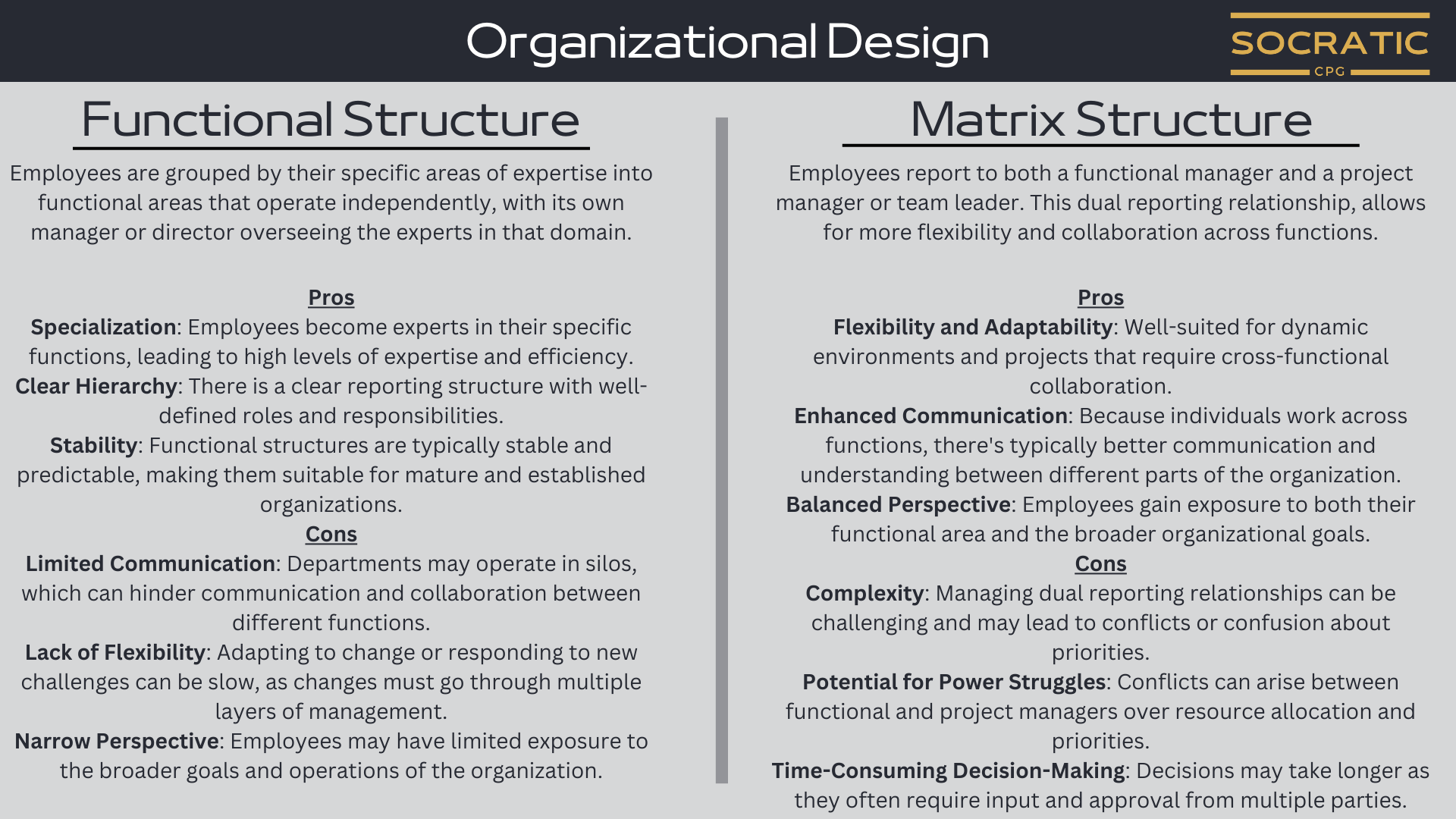
Neville's teams are anchored by their senior executives: a CMO who leads sales and marketing, a COO who focuses solely on manufacturing and logistics, and a CFO who leads finance and operations. With enough VC funding to not have to focus on being scrappy, Neville's organizational design thesis centered around "expert brute strength," and he hired his three lieutenants as hyper-focused experts in their respective realms. He gave his lieutenants similar direction in building out their teams, focusing on candidates who were experts and hyper-focused on the competency of their role. Neville's company was now stacked with highly compensated and highly functioning contributors who were solely focused on their respective competencies. While the talent pool of the organization was undoubtedly strong, a weakness throughout the organization was cross-functional compatibility. However, this was accepted as a necessary evil and teams would muscle through how to work together on an "as needed" basis.
After Neville's decision to move ahead with extended terms with the catnip co-packer, each executive began their respective tasks. The CFO amended the agreement and developed KPIs to stay on track with the new terms. The COO immediately placed production orders with the co-packer and contacted inventory liquidators for the 1.9oz filled product. The CMO made design and creative adjustments and instructed the sales team to submit the changes to brokers, distributors, and retailers. With the team's firepower and the slight adjustment being made, Neville and the CFO forecasted the change would be executed within six weeks.
All teams worked efficiently and completed the change by week six. The internal metric of completion was determined as the moment old inventory was liquidated, and new inventory was slotted into the warehouse within days of each other in the final week. On Thursday afternoon, the COO informed Neville and the other executives that the change was complete, and congratulations were delivered. Neville felt strong in his conviction that his organizational design thesis continues to stand the test of scaling up a growing firm.
During week 7, purchase orders from distributors and retailers start coming in, but they still refer to the 1.9oz description. The customer service team responsible for entering the orders assumes that superficial details take a long time to be updated on item descriptions, so they do not raise any concerns to the sales or operations teams. Similarly, the operations team determines on their own that they can fill the orders with the new product they have in stock, and ships them to their destination.
By week 8, the first purchase orders placed after the internal change was finalized and deemed successful begin to arrive at the docks of distributors and retailers. Here, the products are inspected, counted, and checked into their respective systems. During the check-in process, the UPC is verified (in this case, it remained the same because the change in size was less than 20%) as well as the size.
However, the physical size of the item on the dock (now labeled 2.0 oz) does not match the size in the system (1.9 oz). As a result, the system will not allow the pallets of product to be checked in, and the receiving departments reject them. These pallets of product are subsequently quarantined within the warehouse and added to the list of daily issues that need to be processed within 24 hours.
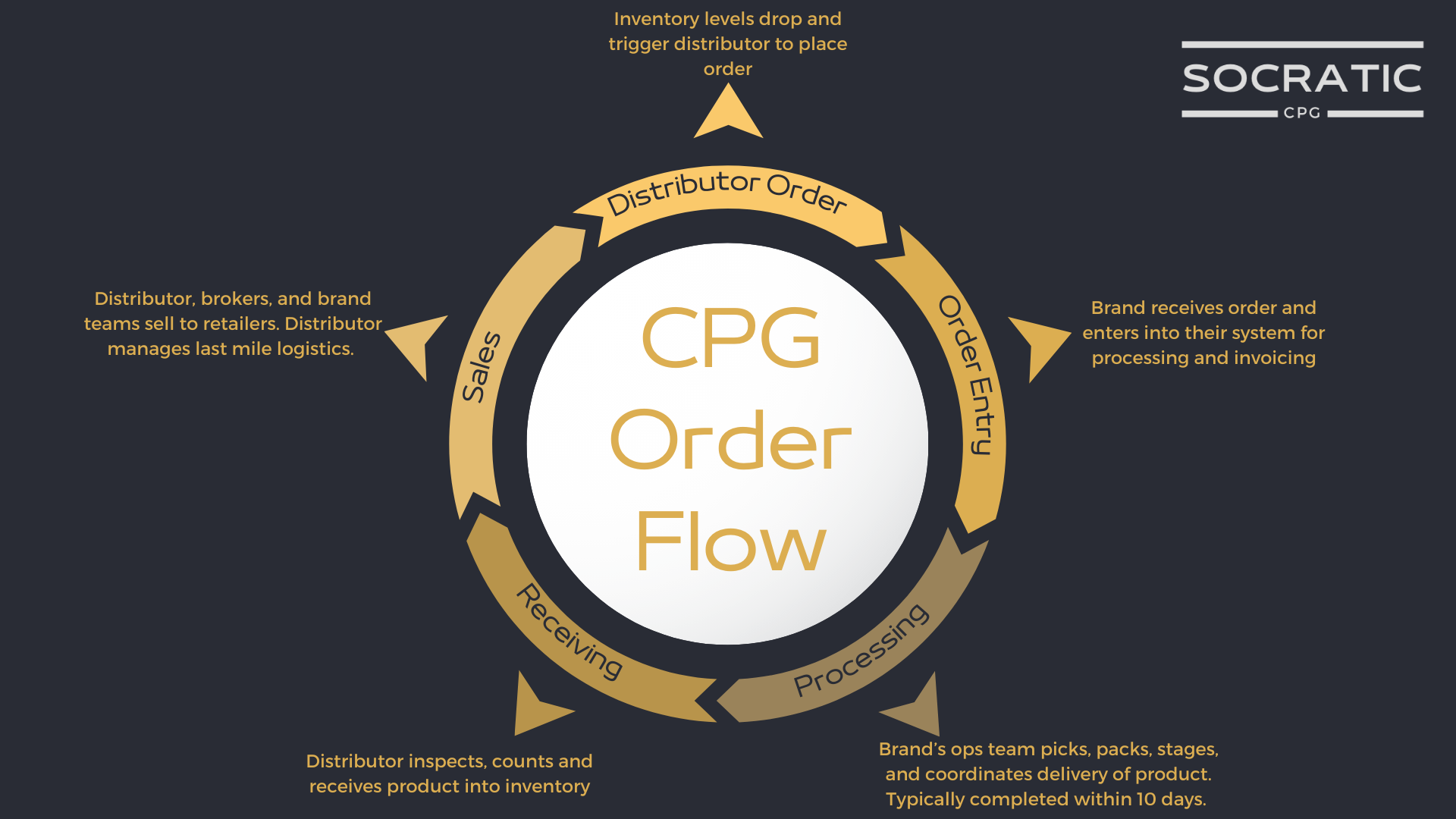
Neville's logistics team has started receiving emails from customer receiving docks indicating that the pallets are being rejected due to disparities in item specifications. The team needs to make arrangements for the product to be returned to Neville's warehouse. They have started the process of scheduling logistics services to bring the product back while also escalating the issue internally.
Due to their efficiency, Neville's logistics team consistently schedules these return deliveries for the morning following each issue that arises. As a result, the pallets are quickly returned to Neville's warehouse.
Due to the significant costs associated with carrying inventory, the Consumer Packaged Goods (CPG) industry has adopted a "just-in-time" logistics model. Under this model, customers (distributors or retailers) calculate their average daily volume sold, the amount of inventory they have on hand, and the lead time required to fulfill a replenishment order. They then place a purchase order with their vendor (in this case, Neville) on a day that ensures they will have "just enough" inventory to get them through a few more days when the product is delivered to their warehouse. Although this approach can be challenging and requires accurate forecasting models, it reduces warehouse inventory costs and minimizes the risk of product spoilage or expiration. Therefore, transitioning to a just-in-time model is considered a worthwhile investment. This inventory and logistics model is used not only by distributors but also by retailers, as it reduces the size of back rooms required to store inventory in stores and the size of their own warehouses.
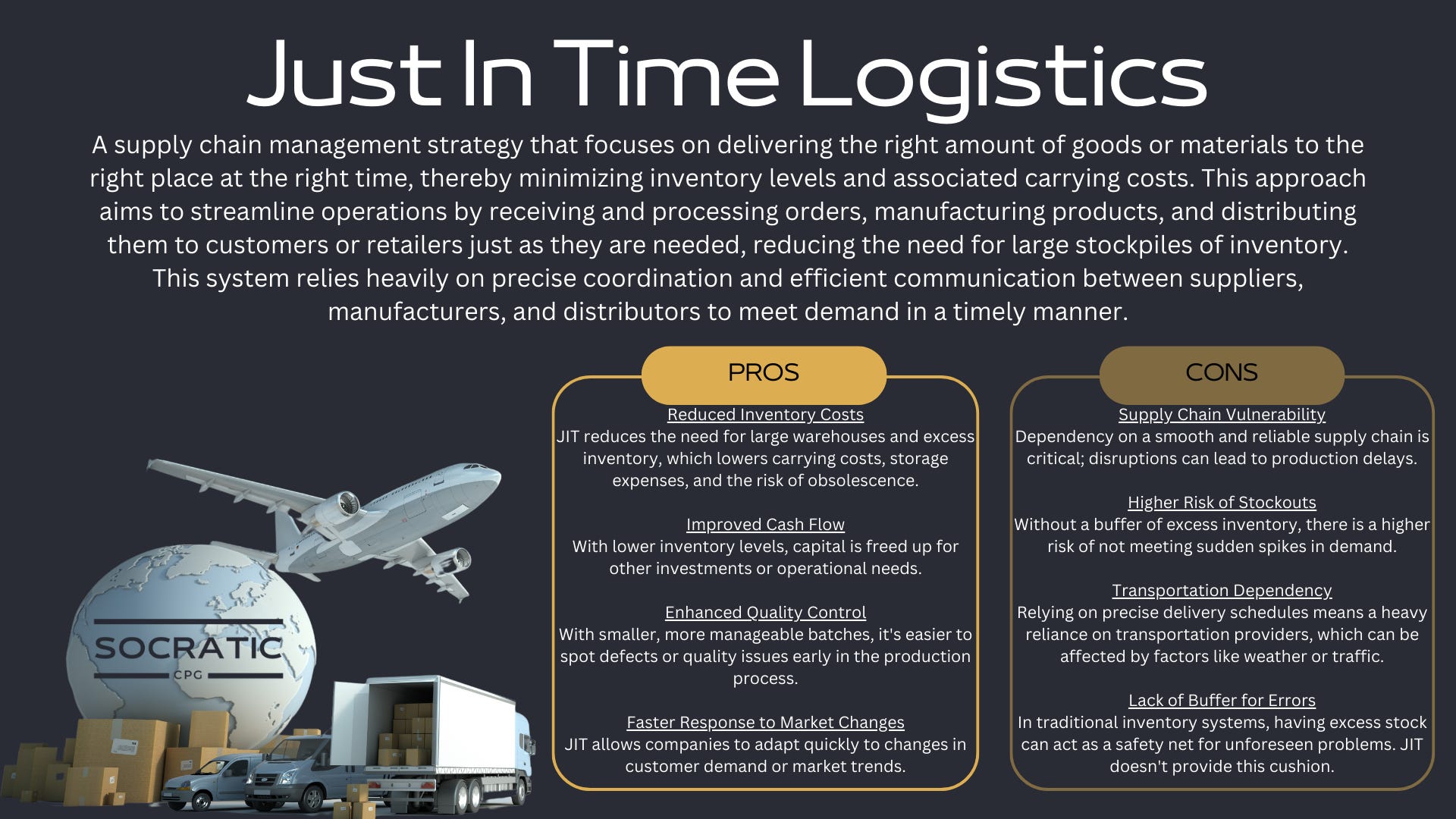
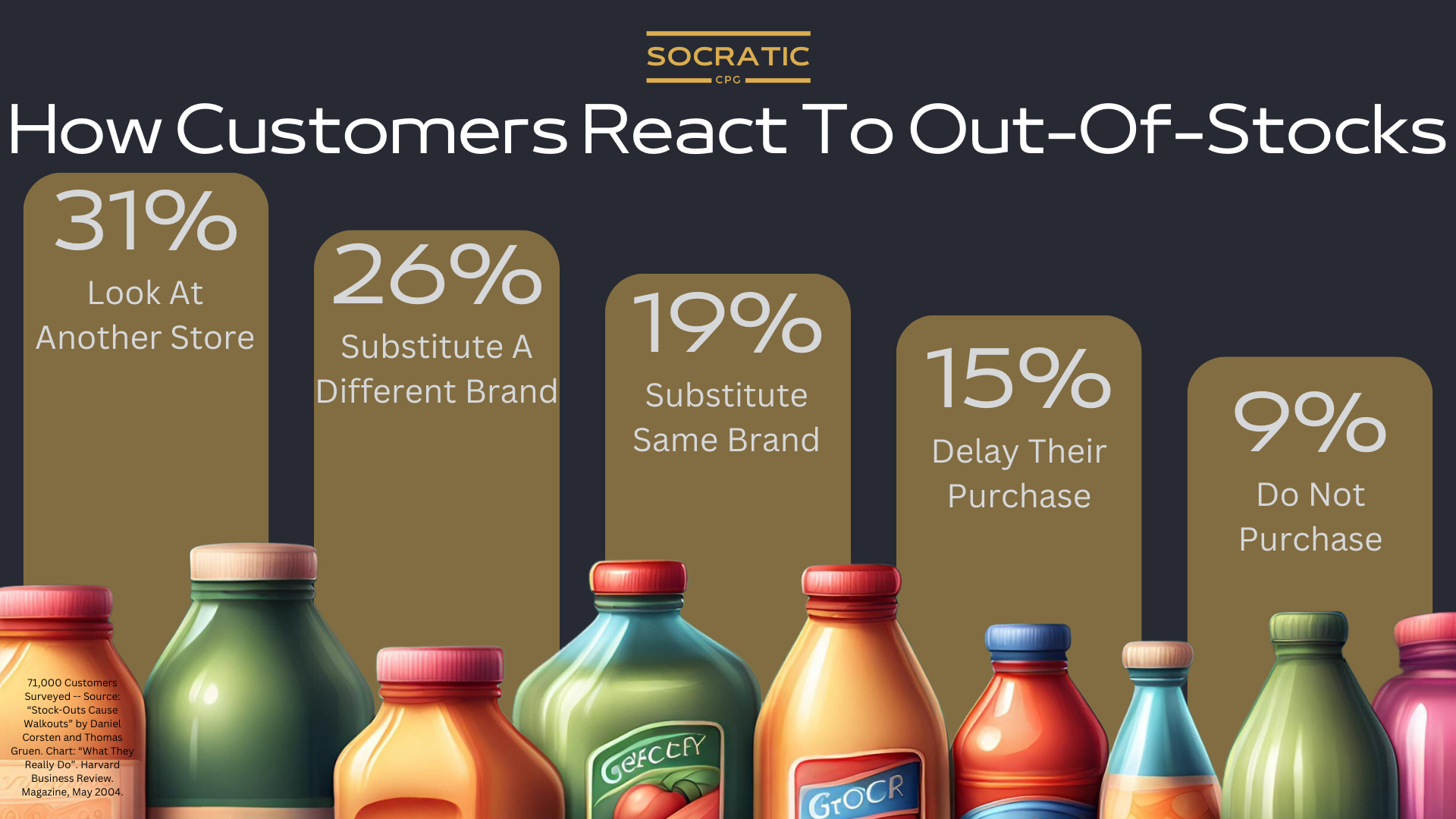
By week nine, Neville's sales team began receiving emails from its brokers, distributors, and retailers stating that their catnip was no longer in stock in warehouses and there was empty shelf space in retail stores. As the days passed, the number of concerned emails and phone calls only increased. Neville and his team had done an excellent job over the last two years of increasing their market share in the catnip category. They had consistent repeat customers, and every major retailer in the country either already had their product on their shelves or was in the process of doing so. However, they were now out of stock nationwide. Distributor racks were empty, and competitors were double-stocking their slots on retail shelves with the empty space left by Neville's product. Neville is not only losing customers today, but also a significant percentage of customers who transition to other brands today may not transition back to Neville's catnip once it is back in stock. The most aggravating part is that Neville is sitting on a warehouse full of freshly produced product, and the only way it can leave the loading dock is through e-commerce orders.
What went wrong? How quickly can this be resolved? Could this have been prevented?
Analysis
Internal Factors
Silo’d nature of COO and CMO structures
The most obvious point of failure in Neville's organization is the siloed nature of its functions. Such silos often form due to a lack of cooperation among teams or leadership, but in Neville's case, there was no surface-level animosity among them. The problem was that Neville opted for a company full of hyper-focused experts, instead of an organizational design of experts as a center of gravity with well-rounded "pros" surrounding them. While this can create excellent work products, it also creates a culture of staying in one's lane and never venturing out to think beyond one's own realm. In the consumer packaged goods industry, an organization needs to think four or five orders beyond to survive.
Reliance on the COO for a single KPI of success
Neville's organization doesn't promote cross-functional work, and as a result, Neville and the CFO didn't consider the need for multiple KPIs across a prolonged timeline to accurately measure the success of changing the catnip item. After getting input only from the COO on the operational steps involved in the change, they set a completion date and deemed it a success. Although it was reasonable to draw a line in the sand at 6 weeks for "internal transition, phase 1," the critical failure was stopping the process there. If Neville and the CFO had consulted with the CMO as extensively as they did with the COO, they would have realized that a "phase 2" was necessary, with KPIs aligned with customer execution on a slightly longer timeline.
External Factors
90 Day change notice, underweighted sales input
The item was rejected at the receiving dock and ultimately ran out of stock on shelves across the country due to a required notice period that prevented the slightly updated item from being accepted into respective systems immediately. In Neville's case, a majority of his distributors and retailers had 90-day notice periods. This meant that the updated product could not be accepted by warehouses or stores until 90 days after Neville's sales team or brokers submitted the respective change-forms to their customers. Unfortunately, this notice period was not taken into consideration when determining the sole KPI that would determine when the project was complete.
Because the COO was tasked with liquidating the 1.9oz product when the 2oz product was produced, there was nothing to fall back on to fill orders during the notice period. This resulted in the product going out of stock very quickly.
Recommendation
When conducting a post-mortem for Neville's project, it was quickly determined that three factors played equal parts in the new version of the catnip going out of stock at retail. Therefore, not much time was really needed.
When building out a process that Neville's organization can follow for item changes in the future, we need to be aware of his preference for expert-only instead of expert-centered organization building.
Core Themes to Consider Before Tackling Item Changes
When starting these projects, senior executives should emphasize the following themes in their instructions and reiterate them frequently:
Open lines of communication
Keep the lines of communication open by providing regular updates on the project to your boss, teammates, and counterparts in other business functions.
Comprehensive note-taking
Every contributor and executive assigned to the project should take comprehensive notes throughout the process and store them in a communal location for everyone to review. Notes should include conversations with vendors, suppliers, service providers, customers, and internal stakeholders. Team members should take a few minutes each day to review new notes and consider whether they impact their role in the project or if they might affect another team member's role.
Tackling Item Changes
Operations
Does this require a UPC change? Seek professional legal advice only.
Initial lead times for updated labels and/or packaging
Sales
Fact gathering calls with your brokers.
Discuss the details of the change with the relevant stakeholders and obtain their high-level thoughts on the requirements for implementation.
Internal Takeaway: In two weeks, the sales team should have a plan for how to implement a clean item change with each of their key customers. This plan should include identifying internal stakeholders responsible for form filling, established internal points of contact for manufacturing, logistics, marketing, and finance, timelines for updating the sales deck, sell sheet, and spec sheet, form submission dates, and effective dates. In addition, the sales team should compile a comprehensive cost readout for each key customer, including distributors. While exact numbers are preferable, a formula used by each customer to determine the cost of the change should suffice. This readout should include submission fees, execution/implementation fees, reset/planogram fees, and the formula for how the cost is shared on excess inventory counted on the effective date.
External Takeaway: In one week (inclusive of the Internal Takeaway), brokers should have a comprehensive list of all customers and their requirements for item changes. This list should include timelines, key points of contact, flat fees, formulas for variable fees, and respective forms for each customer in which they are required.
Work backwards to build submission deadlines for all distributors, retailers, and other partners that require it.
Marketing
Do the labels require updating? Answer with a simple YES or NO.
Build workflows and timelines for art updates.
Build workflows and timelines for copy updates.
Take inventory of marketing assets and determine what needs to be updated and what needs to be disposed of.
Create a timeline for website updates.
Designate a quarterback for online and ecommerce asset, copy, and description updates.
Finance
Conduct an analysis to compare the liquidation and sell-through of old products.
This analysis should involve collaboration between sales and operations.
No action should be taken until the analysis is reviewed by all stakeholders and the most appropriate path for your business is decided upon.
Forecast write-downs for raw materials, existing inventory, agreement breaks, and any other applicable costs related to the soon-to-be old product.
This needs to be cross-collaborative between sales and ops
Update your COGS analysis and clearly communicate the margin impact
Related Reading
HBR | Stock-Outs Cause Walkouts
Although published in 2004, this short read is filled with insightful anecdotes that offer additional perspective on the inner workings of retailers.
WSJ | Inside Apple’s Spectacular Failure to Build a Key Part for Its New iPhones
Apple is known for being tight-lipped about internal politics, so the details surrounding their failure to design a silicon chip are a rare treat for leaders interested in the “processes of process.”
A textbook case of not all item changes requiring public notice, the Toronto Star does a good job of discussing "skimpflation" and how ingredient changes are more common than consumers might think.
Mashed | Dark Meat McDonald's Chicken Nuggets Used To Be A Thing
This is a fun and quick read that explains the fact that McDonald's Chicken McNuggets used to contain dark meat. Just a little trivia for you!
Resources
Feel free to use these resources in your own decks and presentations.


Socratic CPG
Socratic CPG is a boutique consulting firm that specializes in supporting the success of Better For You focused consumer brands. Our areas of expertise include startup coaching, profitable scaling, asset light operations, and distribution strategies. For more information, please visit our website at www.socraticcpg.com or reach out to John Henry directly at JohnHenry@SocraticCPG.com.